


When you read about Artificial Intelligence in the news, it can sound like algorithms are ready to manage every aspect of our lives. In the world of finance, AI is undeniably changing the landscape. It can process mountain-high stacks of data, build portfolio scenarios in seconds, and run complex financial calculations faster than ever before.
But when it comes to your life savings, your family's security, and your retirement dreams, numbers on a spreadsheet are only half the story.
While AI excels at processing information, it struggles with human emotion, personal values, and real-world judgment—the very factors that determine long-term financial success. Here is a look at how AI is shaping financial guidance, where technology falls short, and how we leverage modern tools to deliver better advice for your life.
How AI Is Changing Financial Advice (And How It Isn't)
Today, many financial professionals—including our firm—use AI as a high-powered assistant. It helps us summarize research, transcribe meeting notes, run portfolio scans, and stress-test scenarios in minutes rather than hours.
By letting technology handle the heavy lifting on technical chores, we free up what matters most: more time to focus on you, your goals, and your family.
The Real Gap in Wealth Management: Behavior, Not Knowledge
To understand why a human advisor is essential, look no further than how investor returns actually play out in the real world.
Morningstar’s long-running Mind the Gap study revealed that over the decade ending December 2024, the average investor in U.S. funds earned about 1.2 percentage points less per year than the funds themselves returned. Why? Because people frequently fell into the classic trap: buying after securities went up and panic-selling after they fell.1
The takeaway: Investors didn't underperform because of a knowledge gap. They underperformed because of a behavioral gap.
An AI chatbot can tell you that selling in a downturn is statistically unwise. But when market volatility makes your stomach drop and your instincts scream "get out," a chatbot can't offer empathy, perspective, or a calming phone call. A trusted financial advisor who knows your life story provides the voice of reason when you need it most.
What Is a Financial Advisor Really Worth?
When measuring the value of financial advice, the real impact isn't found in stock-picking or timing the market, it’s found in strategy and behavior.
Vanguard’s long-running Advisor’s Alpha work estimates financial professionals can add roughly 3 percent in net value, and the single largest component, worth more than 1.5 percent on its own, is behavioral coaching.2
According to the 2026 Employee Benefit Research Institute (EBRI), 83 percent of workers with access to a financial advisor feel confident about their retirement readiness, compared with just 53 percent of those without access. The EBRI research suggests that professional support can help people feel more confident about how they approach the future. The role of the financial professional appears to be evolving into that of an interpreter, coach, and strategist.3
We want to be careful with these numbers, they are population averages, not a promise about any one person’s account, and they are not measuring market outperformance. Vanguard marked 25 years of the Advisors' Alpha framework by noting that the advisor's value from coaching and guidance with decisions along the way could exceed that of investment selection.4,5
Do People Trust AI or a Professional for Financial Decisions?
If you prefer a human touch, you’re in good company. A 2025 study by Northwestern Mutual found that 53% of Americans trust a human advisor to build a personalized financial strategy, while only 15% feel comfortable relying on AI alone.6
The study’s own framing is that finance is inherently personal. It's about life goals, legacy, and peace of mind, not just numbers on a spreadsheet.
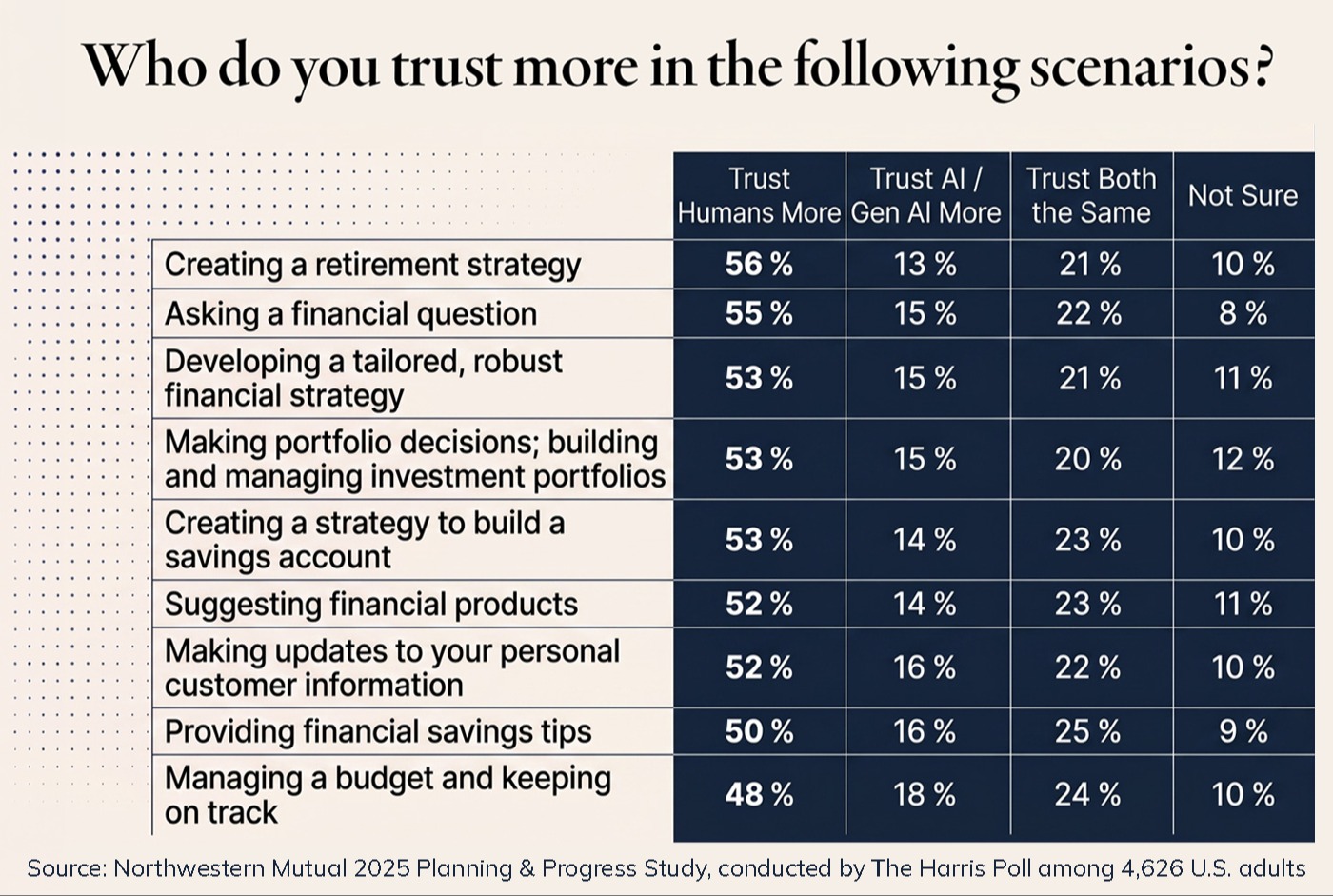
The same research points to where this is heading, and it’s not a replacement story. Younger clients, in particular, now say they prefer working with a financial professional who actively integrates AI tools into their process.6
The future isn't human versus machine; it's a dedicated human advisor whose judgment is enhanced by advanced technology. New technology raises the baseline of what's possible, allowing the financial professional to spend more time on the parts that matter most.
What Can a Financial Advisor Do That AI Cannot?
A trusted advisor exercises judgment on decisions that depend on knowing you personally. The most pivotal choices in your financial life rarely have a single, clean "math equation" answer. They require context, judgment, and personal understanding.
A financial advisor can help you decide whether to take the buyout from your job or hold out for severance. They can help you think through how to support an aging parent who needs extended care without jeopardizing your own retirement strategy and how your risk tolerance might shift after a new child, a divorce, or a health crisis. And they can help you figure out what "enough" retirement income actually looks like for you.
The answers to these types of questions often depend on knowing your history and your personal journey to your current state. AI can give you the textbook answer. We can give you the answer that best suits you and then stay accountable for it, as life keeps moving forward.
Technology serves the Relationship, not drive it.
In our case, we use AI for technical work and deep informational work.
You should expect your financial advisor to use the best available tools, just as you expect from your doctor. You should also expect the technology to serve the relationship rather than replace it. You did not start a relationship with a financial advisor just for the math. You engage one because you want a person, who with an awareness and understanding of your situation from knowing you, your family and your life journey can provide additional perspectives and actionable advice.
At WBI Advisory, we focus on helping clients make proactive, informed decisions about their financial futures. That part of the work was always the point and we are committed to it.
If you’d like to review your current approach to your finances, evaluate market trends, or discuss how we can help you prepare for what’s ahead, we welcome the opportunity to connect.
Frequently Asked Questions
Will AI Replace Financial Advisors?
No. While AI excels at technical tasks like research and modeling, it cannot replace the behavioral coaching, judgment, and personal accountability that drive real-world financial success. Most people still prefer human insight for major financial decisions.
How Do Financial Advisors Use AI?
Advisors use AI tools to automate routine tasks, scan portfolios, and run complex financial scenarios quickly. This efficiency allows advisors to spend more one-on-one time focusing on client strategies and relationships.
Is a Financial Professional Worth the Cost in the Age of AI?
Yes. Vanguard research indicates that financial advisors can add up to 3 percent in net value, with the majority coming from behavioral coaching and strategic guidance rather than simple investment selection. Those are population averages, not guarantees for specific performance.
Can I just use an AI tool instead of hiring an advisor?
We used to say, the financial advice columns in your news paper is educational content, a starting place for ideas, not always suitable or applicable for your specific situation.
Similarly, AI tools can offer basic educational answers, but it cannot account for your personal history, manage your emotions during market swings, or keep you accountable to your long-term goals. We have several examples from client conversations where they have used AI and bring questions into our meetings, where its recommendations were against the clients interests. Once we explain our thoughts, the response is almost always, "glad we did not act before speaking with you".
1 Morningstar.com, November 7, 2025. Mutual funds are sold only by prospectus. Please consider the charges, risks, expenses, and investment objectives carefully before investing. A prospectus containing this and other information about the investment company can be obtained from your financial professional. Read it carefully before you invest or send money.
2 Vanguard.com, 2026.
3 EBRI.org, 2026.
4 RussellInvestments.com, 2026.
5 Vanguard.com, February 24, 2025.
6 NorthwesternMutual.com, August 5, 2025.